How Much Is a Slow Website Costing Your Business?
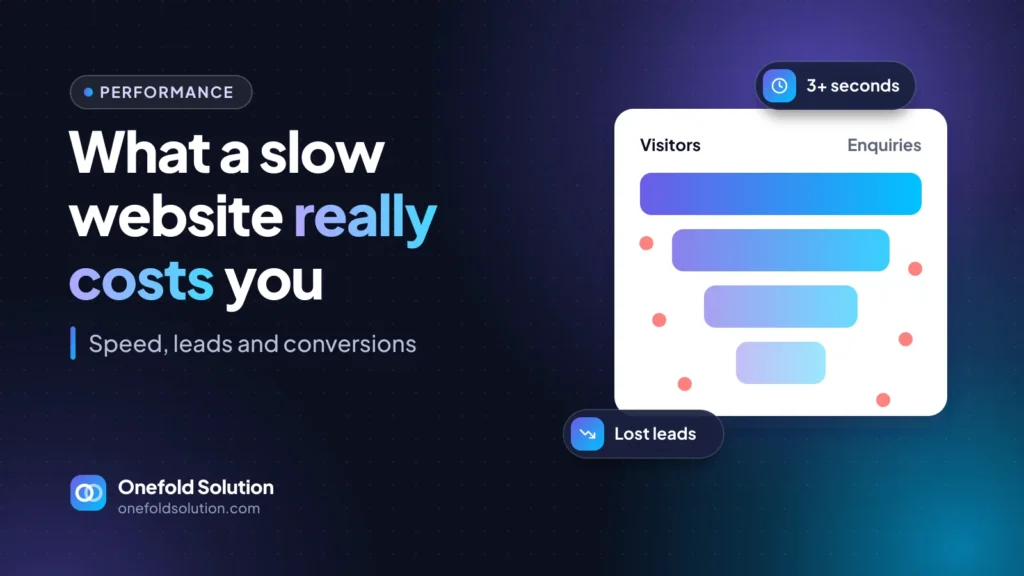
A website can look beautiful and still lose money. If it loads slowly, many visitors leave before they ever read your headline. You never see them in your inbox because they never got that far. This guide explains how website speed and conversions are linked, and how to estimate what slow pages cost you.
Key takeaways
- Slow pages make visitors leave before they see your offer.
- Estimate your own loss with your visitor and enquiry numbers.
- Start with images, hosting and heavy scripts.
What the research says
Google's mobile research (done with SOASTA and published in 2017) is still widely quoted:
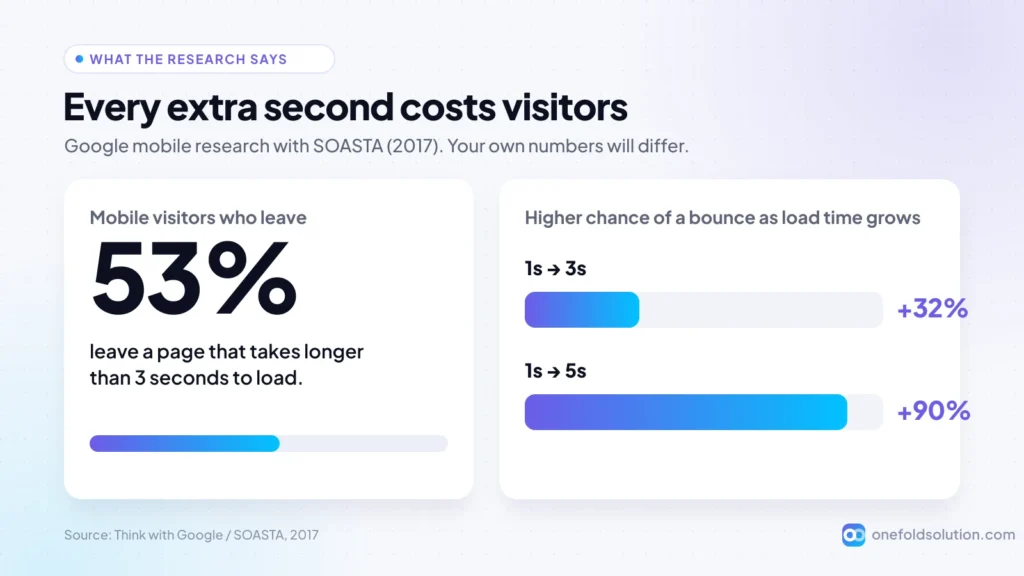
- 53% of mobile visitors leave a page that takes longer than 3 seconds to load.
- As load time goes from 1 second to 3 seconds, the chance of a visitor bouncing rises by 32%.
- From 1 to 5 seconds, it rises by 90%.
This research is several years old, and exact numbers vary by industry, so treat it as a clear direction rather than a promise for your site. The direction has not changed: the longer people wait, the more of them leave.
It is not only about patience
Speed affects three things at once.
Sales and leads. A visitor who leaves cannot call, book or buy.
Search visibility. Core Web Vitals are part of Google's page experience signals. Good scores will not make a weak page rank, but poor ones can make a competitive fight harder. The targets are LCP of 2.5 seconds or less, INP of 200 milliseconds or less, and CLS of 0.1 or less.
Trust. A slow, jumpy site feels unreliable. People ask themselves how careful you would be with their project.
A simple way to estimate your own loss
Here is an illustration with made-up numbers. Please replace them with yours.
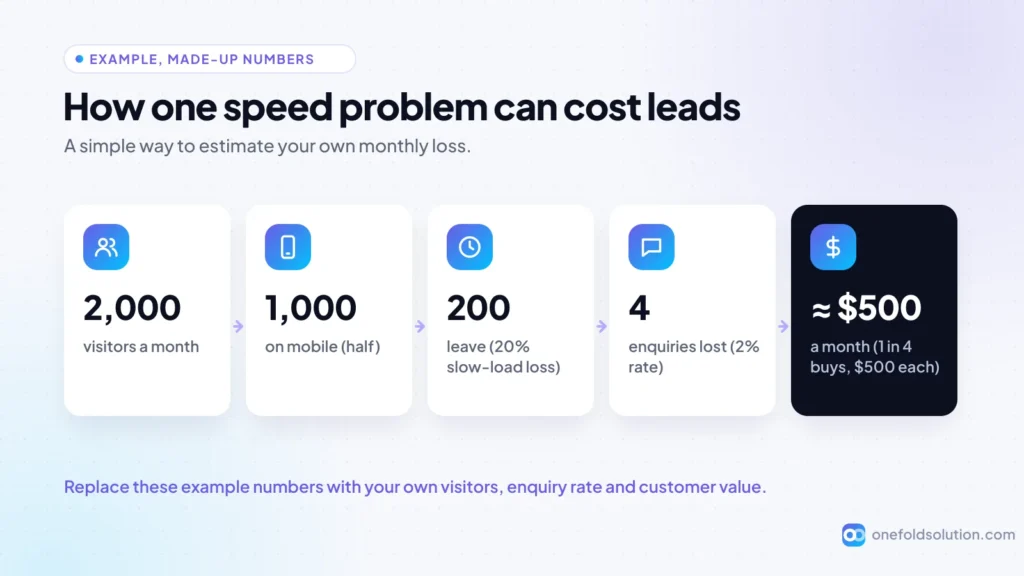
- Your site gets 2,000 visitors a month.
- 2% of visitors become enquiries on a normal day, which would be 40 enquiries.
- Suppose a slow load makes 20% of mobile visitors leave who would otherwise have stayed. If half your visitors are on mobile, that is 200 visitors.
- At the same 2% rate, that is about 4 enquiries lost every month. If one in four enquiries becomes a customer worth $500, that is roughly $500 a month, or about $6,000 a year, from one speed problem.
Your real figures will differ. The point is that the cost is real and it repeats every month.
Where to start
- Test your key pages on mobile with PageSpeed Insights.
- Fix the biggest problems first: images, hosting, heavy scripts.
- Re-test after every change and watch your enquiries, not only the score.
If you would rather skip the guesswork, our free website audit shows your scores and the most important fixes in plain language.
Need help with this?
Onefold can do it for you. See our Web Development, start with a free website audit, or ask us a question.
FAQ: website speed and conversions
Is a perfect PageSpeed score necessary?
No. A score of 100 is not the goal. Pass the Core Web Vitals on real mobile connections and make sure the key pages feel fast.
Does speed matter more than design?
Both matter. A beautiful page that nobody waits for does not help anyone, and a fast page with no clear message does not sell either.
How often should I test my site?
After every major change, and at least once every few months.